
Brookings:Connecting Central Asia to the world
Over a period of about 500 years, from 750 A.D. to 1250 A.D., Central Asia produced some of the world’s finest minds and its workshops produced exquisite goods that were recognized and traded across Europe and Asia. During this period, Central Asia benefitted from being at the center of the Silk Road connecting East Asia to the Middle East and Europe. But by the 18th century, Central Asia has ceased to be the “center of Asia” and was no longer astride major trade routes, as trade between Asia and Europe moved to use sea routes. Worse, during the “Great Game,” the Russian and British Empires agreed on a “buffer” along the northern border of Afghanistan.
With the end of the British Empire in India in 1947 and, more importantly, the Soviet Union in 1991, the artificial divide across Central Asia was removed. With the rapid growth of the Chinese and Indian economies, Central Asia now lies between Asian and European markets that account for two-thirds of the global population, two-thirds of world GDP, and more than two-thirds of global trade.
AFTER NEARLY 200 YEARS OF ISOLATION CAN CENTRAL ASIA ONCE AGAIN BECOME A VITAL LINK IN THE GLOBAL ECONOMY?
Of critical importance to the region is the rebalancing of the Chinese economy: Its center of gravity is moving west, away from the eastern seaboard and closer to the land border with Central Asia. As China moves production inland, land transport through Central Asia to Europe becomes increasingly attractive. For goods being shipped to Europe from Eastern China, the alternative is to first ship eastwards to Shanghai before sailing for six weeks to Europe. For Chinese factories, shipping west by land is cheaper than air and faster than sea transport.
Better connectivity within Central Asia would allow the region to capture an important share of global trade. Major investments are being made to improve transport networks in Central Asia. Under China’s Belt and Road Initiative (BRI), Central Asia is benefitting from ongoing and planned upgrading works. In addition to east-west corridors, there are opportunities for opening up to the south, in terms of reopening ancient trade routes connecting Central Asia to South Asia.
WHAT ARE THE PRIORITIES: HARD INFRASTRUCTURE OR SOFT POLICIES?
Within Central Asia, the ongoing major reform program in Uzbekistan is providing an opportunity to address the regional connectivity agenda. Policies are being adopted to open borders and create regional trading networks. But the region has not yet fully leveraged its geographic position. Central Asia’s greatest challenge is the inefficiency of its borders, which is of greater concern than the quality of infrastructure. “Trading across Borders” is the regions’ weakest indicator in Doing Business: the Kyrgyz Republic is ranked 70th, Kazakhstan 102nd, Tajikistan 148th, and Uzbekistan 165th, while Russia ranks 99th and the average ranking for Europe and Central Asia is 54th. Border delays and unpredictability have a disproportionate effect on economic activity, especially agricultural goods, many of which become worthless if stuck at the border for 2-3 days. However, BRI investments can spur development in Central Asia, estimated at more than 20 percent for each of Central Asia’s five economies. These benefits will be mostly created by policy reforms to reduce border delays—not by infrastructure investments (Figure 1).
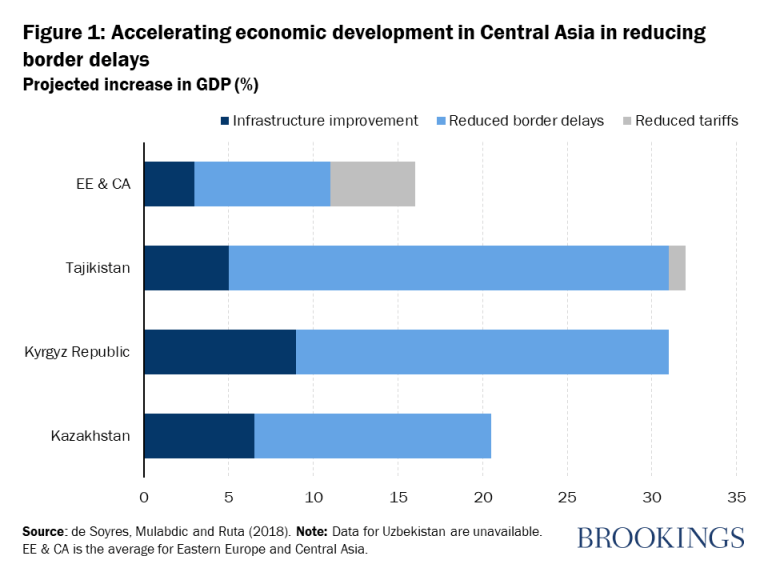

The major gains from BRI are primarily from structural reforms to release procedural bottlenecks that reduce logistics costs, thereby increasing overall trade. Thus, the main benefits will come from adjustments to institutional, legal, and market frameworks.
TRANSIT ROUTES OR FULL INTEGRATION INTO THE GLOBAL ECONOMY?
Central Asia should also look beyond the China-Europe transit trade and take measures to fully integrate with the global economy. This means developing trade corridors that can transform their economies and benefit all people along the corridors. Countries need to change the mindset that trade corridors are merely transport engineering feats designed to move vehicles and commodities. They must develop investment programs based on sound economic analysis of how corridors can help spur urbanization and create local jobs while minimizing negative environmental and social impacts. The analysis must specifically ensure that local populations whose lives are disrupted can reap the benefits of better transport connectivity.
